Searching: Power - 135 Results Found

VTrak Other Why are multiple drives being marked “dead” when I try to synchronize or access my logical drives?
Ken Chou posted this 08 June 2010

The SAS expansion cable is the weakest link in an otherwise cable-less system, and issues can arise due to a faulty cable having a marginal signal that will only cause a transmission problem under very particular circumstances. A SAS cable has a fragile connector inside that could be affected by all of the handling it undergoes from manufacturing to final installation, so care must be taken when unpacking and connecting the cables between the VTrak enclosures.

The Promise VTrak has the ability to report any signal errors that may occur over the two SAS paths from the RAID controllers to the JBOD I/O modules. This can be done by using the serial port and a terminal emulator or using the network port and a telnet or SSH session.

The command to display SAS communication error statistics is:

administrator@cli> sasdiag -a errorlog -l expander -e X -i Y

The two command parameters used to check the individual SAS ports of each RAID controller and I/O module are:

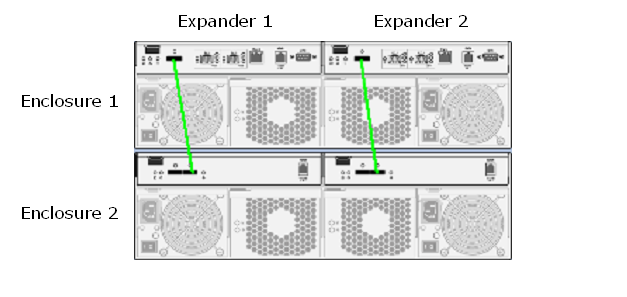
  • -e which refers to the enclosure number, starting with 1, the RAID unit.

  • -i which refers to the expander number, 1 on the left and 2 on the right.

This diagram illustrates the values of these two parameters and the SAS ports they are referencing, which can be best thought of as rows and columns.

Note: additional JBODs would be numbered 3, 4, etc.


For this example, we have one VTrak RAID and one VTrak JBOD, which gives a total of four SAS ports to check.

To display the SAS statistics for the RAID controller on the left we would issue the command:

administrator@cli> sasdiag -a errorlog -l expander -e 1 -i 1

To display the SAS statistics for the JBOD I/O module on the right we would issue the command:

administrator@cli> sasdiag -a errorlog -l expander -e 2 -i 2

This command will return the SAS statistics for each “lane” - denoted by the PHYId - with the first sixteen entries being for the 16 drives in the enclosure, and the remaining eight entries for the SAS expansion port. This means that even though 24 entries are returned, we will only be looking at entries 17 through 24.

administrator@cli> sasdiag -a errorlog -l expander -e 1 -i 1

EnclosureId: 1 ExpanderId: 1

SASAddress: 50-00-15-5d-23-d4-72-3f NumOfPHY: 24

----------------------------------------------------------------------------

PHYId: 1 InvalidDwordCount: 0

RunningDisparityErrCount: 0 LossOfDwordSyncCount: 0

PHYResetProblemCount: 0 DriveFlatId: 1

SlotNumber: 1 IsConnectedtoExtPort: No

ConnectorID: N/A

.

.

.

----------------------------------------------------------------------------

PHYId: 17 InvalidDwordCount: 0

RunningDisparityErrCount: 0 LossOfDwordSyncCount: 0

PHYResetProblemCount: 0 DriveFlatId: 257

SlotNumber: 0 IsConnectedtoExtPort: No

ConnectorID: N/A

----------------------------------------------------------------------------

PHYId: 24 InvalidDwordCount: 0

RunningDisparityErrCount: 0 LossOfDwordSyncCount: 0

PHYResetProblemCount: 0 DriveFlatId: 1

SlotNumber: 1 IsConnectedtoExtPort: No

ConnectorID: N/A

The error counts we want to examine are:

InvalidDwordCount

RunningDisparityErrCount

LossOfDwordSyncCount

They should all be “0” if there are no transmission errors detected on the port.

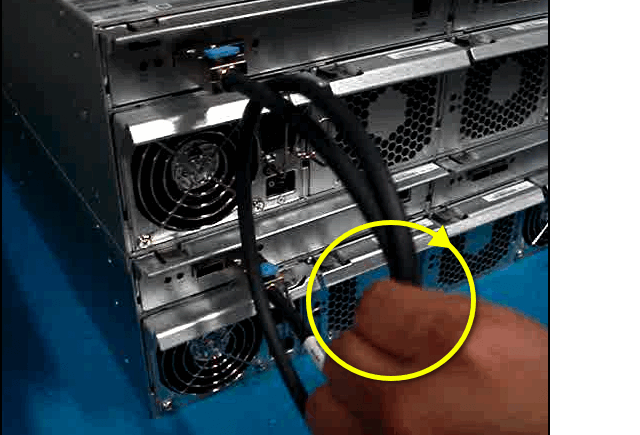
To test the quality of the SAS expansion cable and attempt to induce any errors that may occur due to a marginal cable, we will perform what is referred to as a “wiggle” test. This involves holding the cable near the center and slowly moving it in a circle approximately two to three inches in diameter for a few seconds. Please see the attached video.


Use the sasdiag command again to display the SAS statistics for the two SAS ports that are connected by the SAS cable under test:

administrator@cli> sasdiag -a errorlog -l expander -e 1 -i 1

administrator@cli> sasdiag -a errorlog -l expander -e 2 -i 1

If any SAS errors occur, the counts for PHYIds 17 through 24 could increase.

----------------------------------------------------------------------------

PHYId: 17 InvalidDwordCount: 127

RunningDisparityErrCount: 11 LossOfDwordSyncCount: 5

PHYResetProblemCount: 0 DriveFlatId: 257

SlotNumber: 0 IsConnectedtoExtPort: No

ConnectorID: N/A

If the test results in these counts increasing, power down both the RAID head and attached JBODs and then unplug and re-insert the SAS cable(s). Power back up and re-run the test. If the counts continue to increase, replace the SAS cable and test again.

To make it easier to recognize any incrementing errors, you may want to clear the SAS counters. For a VTrak running firmware SR2.5, the RAID controllers must be restarted. For firmware SR2.6 you can use this command, remembering to run it for each expander:

administrator@cli> sasdiag -a clearerrlog -l expander -e 1 -i 1

Note: the controller restart method must be used for the VTrak for Mac.

Additional Information:

-PHYIds 17-20 signify the "Out" port on the controllers/IO modules.  They are identified by the "Circle" on the rear of each module.

-PHYIds 21-24 signify the "In" port on the controllers/IO modules.  They are identified by the "Diamond" on the rear of each module.

VESS Other Replacing the Cache Battery on the Vess RAID subsystems.
Ken Chou posted this 18 May 2010

Replacing the Cache Battery
The cache battery, or Battery Backup Unit (BBU), is located inside the RAID
Controller. The battery assembly is replaced as a unit.

Cautions
• Try reconditioning the battery before you replace it. See
page 94 or page 143 for more information.
• If power service has failed, do not remove the RAID Controller
if the Dirty Cache LED is lighted. See Figure 5. Wait until
power service is restored.
• Only a qualified technician should perform this procedure.
• You must shut down the VessRAID subsystem before you
can perform this procedure.
• Installing the wrong replacement battery can result in an
explosion.
• Dispose of used batteries according to the instructions that
come with the battery.

To replace the cache battery:
1. Verify that the Battery LED is amber or red. See Figure 5.

Figure 5. VessRAID enclosure LED

2. Shut down the VessRAID. See “Shutting Down the Subsystem” on page 82
or page 188.
3. Remove the RAID Controller.
See “Replacing a RAID Controller” on page 225. (Section Included Below)
4. Lay the RAID Controller on a non-static surface and remove the cover
attaching screws, one on each side, then remove the cover.
See page 227, Figure 3.

Figure 3. RAID Controller cover and attaching screw

5. Remove the battery assembly attaching screw on the outside of the RAID
controller housing.
6. Detach the battery connector and remove the battery assembly.

Figure 6. RAID Controller cache battery

In the above photo, the memory module was removed so you can see the
battery connector. You do not have to remove the memory module to replace
the battery assembly.

7. Attach the connector of the new battery assembly.

Figure 7. Battery connector pin


8. Put the battery assembly into place and install the attaching screw.
9. Replace the RAID Controller cover and install the two attaching screws.
See page 227, Figure 3.
10. Reinstall the RAID Controller.
See “Replacing a RAID Controller” on page 225.
This completes the cache battery replacement procedure.

Exert from the "VessRAID 1000s Series Product Manual" pages 228-230


Replacing a RAID Controller
The RAID Controller monitors and manages the logical drives. When the
controller is replaced, all of your logical drive data and configurations remain
intact because this logical drive information is stored on the disk drives.
RAID Controller failure is rare. But you might have to remove and reinstall the
same RAID Controller in order to replace a cooling fan, cache battery, or memory
module as described in this chapter.

Caution
• Do not replace the RAID Controller based on LED colors
alone. Only replace the RAID Controller when directed to do
so by Promise Technical Support. See page 305.
• Only a qualified technician should perform this procedure.
• You must shut down the VessRAID subsystem before you can
perform this procedure.

Removing the old controller
To replace the RAID Controller:
1. Shut down the VessRAID. See “Shutting Down the Subsystem” on page 82
or page 188.
2. On the RAID Controller, loosen the thumbscrew, swing the latch to the right
and pull the RAID Controller out of the enclosure.
3. Disconnect the SAS, Ethernet, serial, and power cables.
4. On the RAID Controller, loosen the thumbscrew, swing the latch to the right
and pull the RAID Controller out of the enclosure. See Figure 1.

Figure 1. Removing the RAID Controller

Installing the new controller
1. Verify that the new RAID Controller has a cache battery and memory module
installed.
If it does not have these items, transfer them from the old RAID Controller.
See page 228 and page 230 for more information.
2. Carefully slide the new RAID Controller into the enclosure.
3. Swing the latch to the left and secure it with the thumbscrew.
4. Reconnect the SAS, Ethernet, serial, and power cables.
5. Switch on the power.
The VessRAID restarts. For more information about VessRAID’s start-up
behavior, see “Connecting the Power” on page 21.
This completes the RAID Controller replacement procedure.

Exert from the "VessRAID 1000s Series Product Manual" pages 225-226

Close